The cost of business as usual in the AI era.

The future of enterprise growth depends on moving past siloed tools such as email, chat and video, and embracing a modern work operating system.

1TABLE OF CONTENTS
Part 1

Why email is a liability

Every company already runs on a productivity system, even if they don’t realise it. For many, that system hasn’t changed in decades. The same trio of apps that defined the early internet era still rules the modern workday: email, chat and video meetings.

In an AI-first era, this model collapses under its own weight. Tools that were once the centre of digital work have become its biggest bottleneck, trapping information in inboxes, fragmenting context across tools, and forcing AI to work with partial data and incomplete understanding.

The problem isn’t your people. It’s the system: one designed for a world before AI, automation and the scale of modern business.
The fragmented tech stack that we’ve tolerated as the cost of doing business is now opportunity cost in the AI era.
Workers receive an average of 117 emails daily, with heavy users spending nearly nine hours per week managing their inboxes, according to Microsoft.1 Meanwhile, digital interruptions bombard employees every two minutes, totalling 275 interruptions daily. Video meetings are also surging, with after-hours calls rising 16% year on year, stretching the workday and fragmenting attention even further.

Point solutions such as project management trackers and note-taking apps have emerged to patch the gaps, but they drive efficiency in pockets, not at scale. Each one solves a fragment of the problem while creating more silos for people and AI to bridge.

A customer image
‘In this age of AI, I am not simply thinking about innovating. I am trying to reimagine what businesses look like from the ground up.’
Prasad Swaminathan
Group SVP and Global Head of HR, Adecco

Part 2

The great work reset

The way that we work hasn’t kept up with the way AI works. If we’re honest, it doesn’t even reflect the way that humans work.

Most organisations have modernised their infrastructure, analytics and CRM systems but not the employee experience layer, where the work actually happens. Employees still spend more than half their week navigating disconnected systems instead of moving work forwards.

Work gets done. Businesses grow. But beneath the surface, we’ve accepted the time we waste on tedious tasks such as constantly switching between fragmented conversations, apps and data scattered across email threads, chats and dashboards.
The numbers tell the story: the average SaaS management platform integrates with 114 SaaS applications. Yet, organisations are generally only aware of 40 per cent of applications that are actively in use, and Gartner estimates that up to 25 per cent of provisioned SaaS licences go unused, driving overspend and reducing visibility.

In the AI era, this model of work is a liability. Over the next decade, the divide between companies that grow and those that stall hinges on their ability to reimagine how work happens.
Three shifts that are defining the AI era
01

Conversation is essential for AI.

The way that we interact with AI at home, through simple prompts, voice and natural conversation, is now shaping how we expect to work. Employees expect the same intuitive, natural language experiences that they use at home – and that’s exactly how AI agents perform best.

AI derives power from context: understanding what’s happening, why it matters and what comes next.

But conversation isn’t just how humans work best – it’s how AI and agents work best. The richest source of that context lives in conversations where decisions, perspectives, expectations and insights get shared, creating a data goldmine for AI agents.

02

Efficiency is now a growth imperative.

With workforce costs representing over 70% of operating expenses, your people are your most powerful lever for business growth. Organisations that turn human and digital productivity into top-line performance will dominate markets. Those that don’t will see margins erode under inefficiency.

The next generation of enterprise growth demands an integrated work operating system built for humans and AI to operate in one rhythm, one flow, one system of action.

03

AI needs an open, unified operating layer.

Winning in the AI era requires purpose-built AI agents working with your humans across every line of business. But bolting agents onto fragmented apps simply creates chaos. Without a unified platform, employees drown in agent noise and your talent ROI suffers.

The future workforce needs a work operating system where humans, apps, data, AI and agents meet in one place, sharing context, taking action and learning together. This maximises your greatest investment: talent.
Part 3

The inbox and chat trap

Email remains the default communication tool for most enterprises, and every email-first organisation supplements it with basic chat tools such as Microsoft Teams. This dual-system approach sounds practical on paper: email for official communication, chat for quick collaboration.

In reality, it fragments the rich context that AI needs to perform at its best. This division creates work across two systems: two workflows, two search experiences, two places where context disappears.

AI fails when tools aren’t connected. Modern work needs one platform to bring them together, not two systems of communication. Investment roadmaps confirm the limitation: companies are continuing to develop tool-centric AI features and integration patches designed to bridge the gap, not close it.
Teams doesn’t eliminate the inbox – it reinforces it. Worse, it introduces yet another app for users to toggle between.
Why Teams hasn’t displaced the inbox
Teams was designed for small group conversations, not as a system of record. Outlook-centric AI features, such as Copilot in Outlook, and Loop components bridge the two legacy platforms. If Teams were the foundation for modern work, these patches wouldn’t be necessary.
The deeper issue is architectural. Teams wasn’t built from the ground up for how work happens in the AI era; it was designed around SharePoint, a 2001 document management system. The rigid containerisation of Teams forces a trade-off between discoverability and governance.
The limitations are predictable. Channels are difficult to discover across the organisation. Each team has a channel limit, forcing companies to create multiple teams and fragment knowledge further. Only team owners can add members, restricting visibility and slowing collaboration. Channel types (public, private, shared) are permanent – if a public channel needs to become private, the only option is to delete it and rebuild.
The result is fragmented knowledge across countless micro-workspaces. This architectural rigidity forces employees to chase conversations, recreate channels and fall back on email to keep everyone informed.
In the AI era, this architecture can hinder productivity. AI needs systems where conversations create lasting, searchable, connected context. SharePoint’s folder-based model was designed to organise files, not power intelligent work.
When work is locked in rigid containers, AI can’t see across them. When default permissions restrict who can join conversations, AI can’t learn from organisational knowledge. When structural limits fragment organisational knowledge, AI loses the connective tissue that makes it effective.

The AI era demands something fundamentally different: a platform where humans and agents share the same continuous context, where conversations don’t die in silos, and where the system itself is designed to make work visible and actionable.
Two tools, one problem
Together, Outlook and Teams form a paradox: One is too rigid to evolve. The other is too fragmented to scale. Both increase the burden on employees to track, switch and stitch together information. Instead of enabling flow, they create friction – and in an AI-first era, that friction limits the productivity gains that organisations need to compete.

Even as Microsoft layers AI across Outlook and Teams, its underlying model hasn’t changed: two tools, two loops, one fragmented experience. The result is the same as it’s been for 20 years: endless messages, scattered context and employees drowning in ‘digital debt’.

If AI is to deliver on its promise, work can’t live in email, tabs or Teams. It needs a single conversational platform that unifies humans, systems and AI agents into an operating system for work.
A customer image
‘You start with Slack as a tool. Then you realise it’s how you run the company.’
Philip Hess
CEO, reMarkable
Part 4

How work evolves in the AI era

To thrive in the AI era, organisations need a modern work platform where people, systems and AI agents come together to share context and take action in real time. This requires rethinking how work moves through an organisation, going from static systems and rigid processes to networks that respond and adapt as priorities shift. Here’s how:
01

Systems of record

Systems of action
Winners in today’s business landscape put data to work. They pull insights from their CRM, data cloud and operational systems directly into the flow of work, where humans and AI agents can act immediately. Instead of toggling between numerous tools and apps, work arrives in context, enriched with intelligence and ready to move forwards.

This is the core of a system of action: a unified space where conversations and data come together not just to record what happened, but to drive outcomes.

02

Rigid processes

Adaptive organisations
Traditional growth meant adding layers; modern growth means removing friction.

Adaptive organisations operate more like living systems. They use shared channels, AI summarisation and intelligent automation to swarm around priorities, resolve issues faster and adjust as they learn. AI accelerates process execution. By embedding intelligence into workflows, companies move from static, predetermined steps to continuously adaptive ones.

03

Busywork

Purpose-driven work
Repetitive, low-value work is ripe for AI and automation, freeing people to focus on what drives business value: creativity, strategy and relationships. Instead of doing more work, the promise of AI is that it lets you do meaningful work.

Organisations that embrace this shift move faster and create room for innovation at scale.

04

AI tools

Agentic systems
Thousands of companies are experimenting with AI agents, but most run into the same problem: Without context, agents struggle. They hallucinate, stall or require constant human input to stay useful. The next wave of transformation is reshaping work around AI, and context is key.

The richest context doesn’t live in a database, it lives in our conversations. Every decision, clarification and exception that employees make helps AI to understand why something matters. This conversational context forms the foundation of the agentic enterprise, where AI learns to collaborate with humans rather than simply respond.

When an agent lacks context, users spend more time clarifying their prompt than completing the actual task. The solution is to launch agents in an environment where they can observe ongoing conversations.
36%
Time customers save with process automations in Slack5
$5M USD
Box’s estimated cost savings from Slack automation6

The competitive imperative
Modernising work for the AI era means more than deploying AI – it requires re-architecting how work flows through an organisation. To compete, organisations must move beyond disconnected tools and siloed workflows and towards a unified work operating system that connects every human and every agent in a single, intelligent flow of work.

Only then will AI deliver transformative value. Companies that make this shift will accelerate. Those that remain fragmented will stall.
A customer image
‘I tell every founder: Integrate Slack early. It becomes the foundation of how you build, how you scale and how you stay efficient as you grow.’
Jordan Nathan
CEO, Caraway
Part 5

Slack: The work operating system for the agentic enterprise

The future of work isn’t another app. It’s an open, interoperable, AI-powered platform for unparalleled collaboration and limitless productivity.

Slack redefines how modern enterprises operate by bringing people, data, systems, personalised AI and agents into one unified, intelligent workspace. It’s where conversations become decisions, data becomes action and AI becomes an active teammate.

Slack moves organisations beyond coordination to orchestration, from scattered tools to a single environment where work flows naturally.
A centralised workspace that unifies everything
Modern work is fragmented across emails, spreadsheets and standalone project tools. Slack replaces that sprawl with a centralised digital workspace where communication, projects and data live side by side.

Instead of toggling between a dozen applications, teams can see the full picture in one hub – reducing context-switching, eliminating redundant status updates and empowering faster, more confident decisions. For leaders, this means visibility across the enterprise: who’s working on what, where issues stand and how priorities are progressing – in real time.

Slack turns work from something that you have to chase into something that you can see.
A customer image
‘I get a lot of feedback that I’m a CEO who knows every detail of the business, and I think that just means I’m a CEO who’s a power user of Slack.’
May Habib
CEO, Writer AI
A conversational interface that connects humans, systems and AI
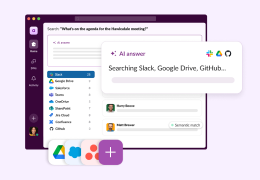
Slack is built around a conversational interface, the most natural, human way to interact with technology. Employees can ask questions, pull data and command workflows in plain language – ‘Show me open customer renewals this quarter’ or ‘Summarise the latest engineering updates’ – and Slackbot surfaces answers instantly from the systems that power your business.

This conversational model transforms how employees work with both data and AI. It reduces friction, accelerates adoption and gives every worker the ability to interact with the full breadth of enterprise systems – no training, no tab-hopping, no lost time.

In Slack, conversation is the interface. And now, that interface includes your AI agents: context-aware, secure and operating alongside your team.
A customer image
‘If I take over a 20-year customer relationship, I want to know the key execs, usage history, contract terms and open issues across Slack, Salesforce and Box. With AI agents, we can surface that context instantly.’
Mark Wayland
Former CRO, Box
Flexible and customisable for all workflows
No two organisations work alike, and no two workflows should have to conform to the same rigid system. Slack is adaptable by design.

Organisations can build custom automations and processes using intuitive, no-code tools such as Workflow Builder or extend Slack with custom integrations for industry-specific needs. Marketing teams can manage launches, Sales can track pipeline progress and IT can handle incidents from the same workspace, customised for how each function actually works.

This flexibility lets work flow the way your business does – not the other way around.
Slack drives sales growth
4x
shorter sales cycles7
2x
faster deal velocity7
36%
increase in win rate7

Connected to every business app and data source
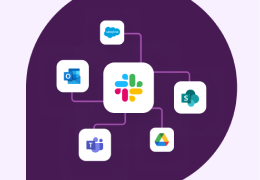
Slack seamlessly integrates with over 2,600 apps and systems – from Salesforce, ServiceNow, Asana, Google Drive and Jira to Microsoft Teams, Drive and SharePoint – making it the connective tissue of the modern enterprise.

Real-time updates keep teams aligned as work evolves. When a deal closes, a campaign launches or a service ticket escalates, the right people are notified instantly in the right channel, complete with context and next steps.

Our enterprise-grade security, governance and compliance ensure that this connectivity happens with the same rigour and trust demanded by the world’s largest organisations.
Designed for the AI era
What makes Slack truly distinct as a work operating system is how it brings humans and AI together in one flow of work.

Through technologies such as the Real-Time Search (RTS) API and Model Context Protocol (MCP), Slack gives AI agents secure access to enterprise context, enabling them to summarise, recommend and act alongside employees in real time.

This is the architecture of the agentic enterprise: a unified environment where data, dialogue and decisions converge. It's where both humans and digital teammates operate from shared understanding.
Making Slack a tool that people actually love
In a world of enterprise tools built for compliance and control, what sets the best apart is design and craft – the kind of experience that employees genuinely want to use. With more than half of enterprise cost tied to people, software isn’t just a utility; it’s what enables your workforce to reach full potential. Research shows that companies with higher employee engagement outperform their peers in productivity, profitability and retention.

When your work platform feels intuitive, fluid and delightful, it drives adoption, creates momentum and helps to attract top talent. Slack turns work from a chore into a flow: one place where conversations, context, apps, agents and data all live.
A customer image
‘I finally have a place where I can communicate with my entire organisation to share experiences, wins and learnings. Plus, we’ve seen massive productivity gains. We couldn’t be happier with our choice to implement Slack.’
Varun Krishna
CEO, Rocket Companies
The Slack channel advantage
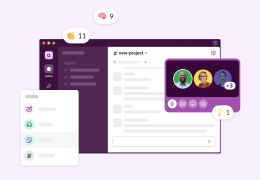
Slack channels are the architectural superpower that make the work operating system model a reality. Unlike Teams’s folder-based structure, inherited from SharePoint, Slack channels are fluid, flexible and limitless. Work can start in a group DM, evolve into a private space, expand across departments or extend externally to partners, without breaking flow or context.

Channels aren’t confined by hierarchy or ownership; anyone can be brought into the work. But they don’t just connect people – they connect everything: files, data, apps, workflows, custom automations and, now, AI agents. Each channel becomes a living collection of context and action – the connective tissue between human collaboration and digital intelligence.

This is the structural advantage of Slack. While others replicate how content is stored, Slack models how work actually happens – open, adaptive and endlessly scalable. It’s why Slack customers operate with shared awareness and momentum, while inbox and SharePoint-based organisations remain trapped in silos.
Where the future of work comes together
Slack is where all of this comes to life. It’s the platform built for this exact moment – where people, systems and AI converge in one intelligent flow of work. It transforms systems of record into systems of action, turning data into decisions. It helps organisations to evolve from rigid hierarchies into adaptive networks, built on shared context and continuous learning. It elevates productivity from a numbers game to purpose-driven work, unlocking the creativity and potential of every employee. And it transforms AI from a set of disconnected tools into an agentic system – one that works alongside people, learning and acting in real time.
Part 6

What the world’s most innovative companies already know

The world’s most forward-thinking organisations have moved to an AI-powered work operating system to orchestrate work.

From AI pioneers such as OpenAI and Anthropic to next-generation innovators such as Rivian, Box, reMarkable and Vercel, the most admired brands on the planet have one thing in common: They work in Slack.

These companies didn’t simply adopt a new tool – they rewired how work happens. Email and static collaboration suites could never keep pace with their speed of innovation, or the velocity required to scale AI-driven businesses. They needed a platform where ideas, context and action could live together in real time.
Email can’t keep up with the speed of innovation.
At these companies, Slack channels are the connective tissue between research, product and operations – where human collaboration meets agentic systems. Rivian uses Slack as its operational backbone, bringing engineers, supply chain experts and customer teams together in shared channels that drive faster launches and faster learning loops. Box’s leadership puts it simply: ‘Slack gives us superpowers. I don’t know how we would run the company without it.’

The pattern is unmistakable. The most innovative and fastest-scaling companies in the world have realised that you can’t build the future from an inbox. The companies shaping the AI era have already moved to a modern work platform – one that’s open, extensible and designed for the new rhythm of human-AI collaboration.

For every organisation still running on email, this is the wake-up call: The next generation of growth is already happening in Slack.
A customer image
‘Slack is our work operating system and how we run our business. It started with Engine from day one and has literally grown with us.’
Demetri Salvaggio
Vice President, Customer Experience & Operations, Engine
Part 7

The call to reimagine work

The age of AI is not coming – it’s here. The question facing every executive team is no longer if AI will transform their business, but whether their operating model will keep up.

Over the past two decades, enterprises invested billions in systems of record – CRMs, ERPs, analytics platforms – and yet the layer where employees actually work has barely evolved. The inbox still mediates decision-making. Meetings still stand in for movement. Context still disappears in silos.

That model simply won’t carry us forwards. The companies defining the next decade – OpenAI, Anthropic, Rivian, Box, Stripe and others – have already proven what comes next: work that moves at the speed of intelligence. Work that happens in one place, where humans and agents operate side by side.

This is the Great Work Reset. It’s the shift from communication to collaboration, from collaboration to orchestration, from orchestration to intelligent action. It’s where productivity, growth and human potential converge inside an operating system built for the agentic era: Slack.
How to get started
01

Audit where your work really lives

Look beyond your tools. Map where decisions are made, context is stored and actions happen. If that’s your inbox, your company is already running behind.

02

Identify your first systems of action

Start where friction is highest: sales execution, service resolution, IT operations. Bring your data, workflows and AI into Slack channels where people already collaborate. Watch the speed shift.

03

Activate your AI foundation

Use secure integrations, Real-Time Search (RTS) API and Model Context Protocol (MCP) to safely connect your AI agents to the full context of your organisation. AI without context is noise – AI in Slack becomes signal.

04

Redefine productivity as growth

Every percentage gain in employee productivity compounds into top-line impact. Treat your work operating system as the most strategic growth platform in your enterprise.
Business has left the inbox.
It lives in an open network where AI and human potential converge to power the next era of growth.

The next generation of growth won’t come from adding more apps, meetings or emails. It will come from organisations bold enough to redesign how work itself gets done.

The future of work has already moved out of the inbox, into Slack.

The question is: Will your business move with it?