Why Slack?
Learn why today’s cutting-edge companies use Slack to drive productivity
More than 200,000 organizations use Slack as their AI-powered platform for work. Times may be uncertain, but forward-thinking companies are committed to innovation and staying ahead of the competition.
Across a range of industries, from banking to grocery delivery, companies such as Square, RBC Wealth Management and iFood are using Slack to optimize team communications, integrate third-party applications and boost collaboration across the enterprise.
By innovating in Slack with features such as personalized chatbots and real-time progress reports, these companies are improving their customer experiences too. Growing business means growing relationships. Slack enables vendors and clients alike to work together and achieve even bigger goals.
What follows are nine stories describing how different large companies build team communications and collaboration with Slack. For example, financial giant Northwestern Mutual sends over 10,000 customized support messages per day. Mapping software company TomTom resolves engineering issues twice as fast as with email and legacy ticket systems. Of Picnic’s 15,000 employees, zero rely on email alone.
According to a commissioned study conducted by Forrester Consulting, interviewed companies saw a 302% return on investment over three years with Slack. Keep reading to learn more.

Northwestern Mutual redefines automation in the financial services industry using Slack
Northwestern Mutual provides comprehensive financial planning and investment solutions to nearly 5 million clients. Key to being one of the longest-running American firms, with more than 165 years of helping people reach their financial goals, the Fortune 100 company provides its thousands of employees and contractors with 24/7 support through its Technical Service Center (TSC).
For a long time, the TSC used a Skype add-on to troubleshoot incidents and provide help. But teams found the application inconsistent, and crucial information was often lost. To help it evolve into a modern workplace, Northwestern Mutual chose Slack.
“I think of Slack as a talent multiplier.”
- Dan Casey, Assistant Director of Product Management, Technology Customer Success, Northwestern Mutual
Now the TSC’s technicians send an average of 10,000 messages monthly in one centralized Slack channel.
By crowdsourcing difficult questions within Slack, advanced support teams’ time is freed up for deep work, issues are resolved faster, and internal analysts have instant access to queries and conversations. And perhaps most importantly, executive leadership can monitor big events in real time without having to track down employees and ask for updates.
One of the biggest issues Slack solved for the company was siloed information. Developers, for example, were often moving between tools such as Jira and GitHub. To address this, the team built a bot on Slack that delivers a report of all microservice components, broken down by environment and alert level. Now developers can automate and perform tasks faster, reducing testing cycles and providing deeper visibility into their productivity for managers.
By using Slack to automate this and other processes, Northwestern Mutual received Slack’s Excellence in Automation Award. The company’s future-looking measures have allowed it to access real-time information, initiate efficient feedback loops and enable transparent communication, all while helping it continue delivering exceptional service to its clients.

Square optimizes remote work and international offices with Slack
Square, one of the largest mobile payments companies in the world, has offices in the U.S., Canada, Japan, Australia, the U.K., and Ireland. Moreover, the company must communicate and collaborate with countless home offices in between.
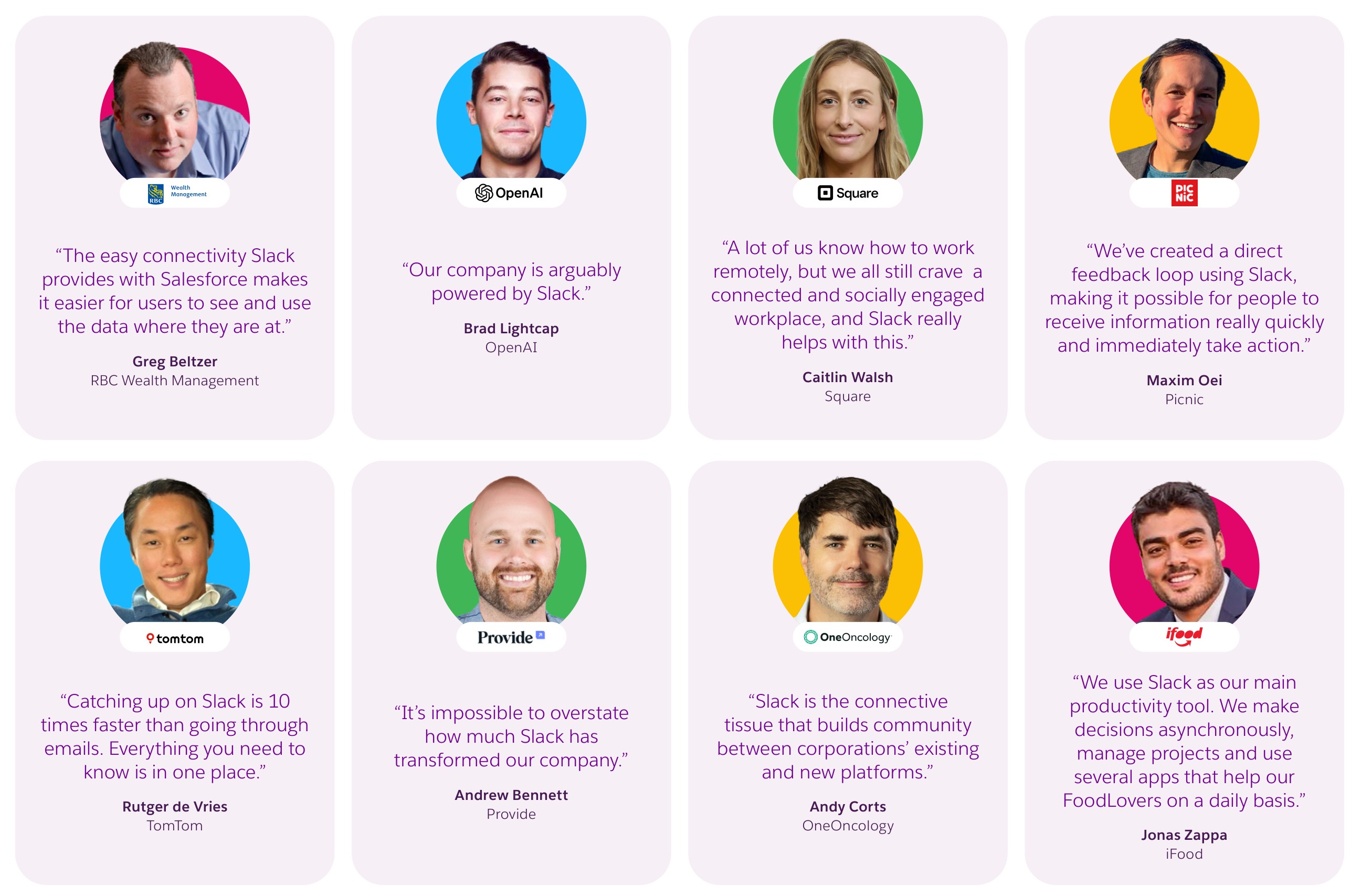
“A lot of us know how to work remotely, but we all still crave a connected and socially engaged workplace, and Slack really helps with this”
- Caitlin Walsh, Communications and Policy Manager, Square
Square’s revenue of $21.92 billion in 2023, up 25% from the year before. Being one of the most forward-looking companies in finance and payments, Square has long relied on Slack to keep its employees on the same page. Each office and team has its own Slack channel for department-specific discussions. This ensures that everyone has the same information about the company’s plans and strategy, no matter their time zone.
Square is widely regarded as one of the best places to work, in large part due to its strong and open culture. Slack has helped facilitate dialogues ranging from the serious, such as the channel #coronavirus-questions, to the playful, such as #wfh-mates, where workers share pictures of their pets.
CEO Jack Dorsey keeps an open line to all employees with #jackama, allowing anyone to ask about Square’s corporate direction and strategy. That connection to the boss enables thousands of employees, no matter where they are, to understand the cohesive vision behind their daily work.
Square uses Slack Connect to maintain tight communication with vendors and external stakeholders. Internally, employees turn to Slack integrations such as Jira to streamline workflows.

RBC manages the operations of its 17 million clients through Slack
RBC Wealth Management, a significant investor in Salesforce’s Financial Services Cloud, needed a productivity tool that could handle complex, time-sensitive issues—one that could easily be plugged into its existing Salesforce infrastructure
This is where Slack’s easy-to-use API and integration capabilities made a perfect fit. Instead of pivoting between multiple interfaces for separate tools, advisors now operate within a single platform that holds all the information and functionality they need to manage customer cases.
“The easy connectivity Slack provides with Salesforce makes it easier for users to see and use the data where they are at”
- Greg Beltzer, Head of Technology, RBC Wealth Management
The company works with a great deal of data, and its technology teams spend a lot of time collaborating on how to build the next best automation tool. As such, building on any non-Salesforce platform would have been prohibitive.
This was once a major challenge. Associates relied on back-and-forth emails among multiple stakeholders. Now they communicate in easily digestible, topic-focused channels that offer actionable details. No more alerts via email, either; RBC Wealth Management’s advisors are alerted automatically through the Salesforce Notification Center app in Slack.
Slack also optimized the company’s sales pipeline. RBC uses a lot of resources prioritizing its leads and referrals. Historically, the sales team worked in different systems and interfaces. Now they have a curated feed of Salesforce leads in their own Slack channel, including call histories, meeting notes and other key factors in driving the business.
Looking ahead, the RBC tech team will turn its focus to Slack AI to empower financial advisors to spend less time on mundane tasks. Slack AI gives financial advisors the ability to summarize complex documentation and conversations, and ask open-ended questions to streamline access to information.

Slack forms the collaboration backbone of OpenAI’s revolution
In 2022, OpenAI released ChatGPT, an AI chatbot that can be used to make sense of large swaths of information and understand complex topics, changing how many search the internet.
While a user interacts with a simple chat bar, behind the scenes OpenAI engineers must juggle tickets, priorities, bugs and other inputs to ensure that the software works correctly.
“Our company is arguably powered by Slack.”
- Brad Lightcap, Chief Operating Officer, OpenAI
They have turned to Slack Connect, which allows them to move conversations out of overstuffed inboxes and into interactive channels. Today the company has more than 170 Slack Connect channels and has sent over 5 million messages since becoming a Slack customer in 2018. Many of those channels are used to provide feedback on OpenAI’s new software models. In other cases, the company uses the Slack API to automate various engineering and testing tasks.
OpenAI also strives to maintain a strong company culture while simultaneously embracing the trend of remote work. This has become possible through Slack huddles, allowing all workers to meet and work together via audio, video, shared screens, and the ability to come and go as they please—just like with an in-person meeting.
In addition, OpenAI is exploring integrating data from Salesforce Service Cloud and Sales Cloud into Slack. This would allow it access to a 360-degree view of each customer—businesses that sign higher-service-level agreements than the average consumer—right from their workstation or phone.
Combining the capabilities of OpenAI’s robust large language model with Slack and Salesforce continues to dramatically improve workplace automation and efficiency.

Picnic brings together all 15,000 employees in a single Slack workspace
As the world’s fastest-growing online supermarket, Picnic’s mission is to make grocery shopping simple, fun and affordable. In seven years, the company has gone from a single employee to 15,000, with over 1 million customers across the Netherlands, France and Germany.
One of the reasons for this, says Maxim Oei, a strategy analyst at Picnic, is that no one uses email. Picnic does the same externally, collaborating with its partners and vendors through Slack Connect.
“We’ve created a direct feedback loop using Slack, making it possible for people to receive information really quickly and immediately take action.”
- Maxim Oei, Strategy Analyst in Technology, Picnic
Oei says Picnic created “a direct feedback loop” with its operations teams using Slack, making it possible for them to receive information quickly and take action. This also ensures that everyone has the same information. With so many moving parts to Picnic’s supply and delivery chains, it is imperative that everyone be on the same page.
The company chef, for instance, created a workflow to reduce food waste and collect information about catering events, such as how many people will attend and dietary restrictions. That allowed teams to unify their meal plans accordingly and optimize operations.
Also, Picnic doesn’t manage separate platforms for safety scores, customer feedback or scheduling. Every metric is summarized in Slack. The company uses some 393 different apps with 86 off-the-shelf solutions from the Slack App Directory in its day-to-day business.
The company has big plans for the future too. It plans to use Slack AI for summarizing incidents, scanning Slack channels and providing updates. In the meantime, maximizing Slack’s potential is giving Picnic the edge it needs to keep growing.

TomTom relies on Slack’s simplicity to optimize collaboration for its 3,900 employees
Since TomTom developed the first consumer satellite navigation device in 2004, it has been a leader in mapping technology, empowering anyone to travel, explore and plan a trip with confidence.
TomTom aims to create a digital mirror of the world. In fact, everything the company does is designed to make life easier and reduce friction—including for its own employees. Today the entire 3,900-person workforce optimizes its productivity and collaboration via Slack.
“Catching up on Slack is 10 times faster than going through emails. Everything you need to know is in one place.”
- Rutger de Vries, Group Product Manager, TomTom
With simplicity at its core, TomTom encourages employees to use the no-code Workflow Builder to automate manual work. And every project, down to the simplest task, has a dedicated Slack channel.
Teams also use Slack huddles for quick check-ins. An internal analysis says this shift has saved employees about half the time they would have spent in a face-to-face meeting.
TomTom’s vision is to pull as much functionality into one place as possible, and it’s using integrations to make Slack the digital destination of choice. For example, TomTom uses the Workday integration to streamline HR approval processes. It allows employees to request and approve annual leave without having to switch applications.
TomTom’s most advanced and engaged Slack users are its engineers, who give Slack a 91% satisfaction rating. With tight service-level agreements from automotive customers, engineers must keep services running 24/7. By centralizing Priority 1 and Priority 2 incidents on Slack, they now resolve them 50% faster.
As TomTom progresses along its internal technology roadmap, the strong partnership with Slack is helping it reach success much faster.

Provide enables better care through its Slack-assisted platform
Provide offers new or expanding medical practices seamless, low-stress borrowing experiences. Since its founding in 2013, the company has leveraged key technologies to ensure that its employees and its partners and vendors have optimized workflows.
That’s why in 2015, as the company was getting its first real momentum, Slack became the backbone for its operations and communications.
“It’s impossible to overstate how much Slack has transformed our company.”
- Andrew Bennett, Chief Business Officer, Provide
10,000 hours of work saved each year through Slack automations. By integrating its loan origination system with Slack’s Workflow Builder, Provide automatically creates deal-specific channels that track statuses, review files and allow teams to collaborate. Workflow Builder updates the channels as deals move through the funding process, keeping everything updated in real time.
Managing a loan, especially in the complex world of healthcare, involves many moving parts, from brokers, underwriters and regulators to all of the necessary documentation and communication that goes between them. Organizing the pieces around clear goals becomes paramount.
Andrew Bennett, the company’s chief business officer, estimates that Provide can handle a loan pipeline two to three times as large with Slack integrated into its tech stack.
Slack also transformed Provide’s IT. The team frequently releases “epics,” a large collection of features released concurrently to support a line of business. When an epic kicks off, the project lead opens a dedicated Slack channel to stakeholders for feedback.
As healthcare providers expand their locations, Slack enables Provide to continue supporting the finances that get them there.

OneOncology organizes dozens of cancer clinics using Slack
Oncologists founded OneOncology with the goal of streamlining data and the communication it takes to treat and manage cancer patients. Since its founding, the company has allowed community oncology practices to remain independent while improving patient access to care at lower costs than a hospital setting.
Collaboration across fragmented clinic sites is challenging too. OneOncology launched OneCommunity, a secure, interactive
“Slack is the connective tissue that builds community between corporations’ existing and new platforms.”
- Andy Corts, Chief Technology Officer, OneOncology
Doctors are known for being particular in their habits, but OneOncology has found great success implementing Slack with its physician partners. Each is happy to reduce their inbox noise with dedicated Slack channels, giving them more time offline to connect with patients.
Using Slack’s no-code workflows OneOncology’s precision medicine team built a molecular helpline. This allows physicians to enter patient information plus specific genomic markers. OneOncology filters that information to the relevant expert, who returns genomic reports in 24 to 48 hours.
OneOncology takes advantage of Slack’s Enterprise Grid, compartmentalizing areas of its work into separate workspaces, including OneCommunity and another for external conversations hosted in Slack Connect. Enterprise Grid enables HIPAA compliance and ensures patient privacy via other protected health information security measures.
online platform across 15 practices and more than 130 U.S. clinic sites. Physicians communicate instantly with a genomic concierge service and they can access crucial content for care, such as clinical trial listings, virtual tumor boards and asynchronous learning opportunities.
Clinical work, especially with cancer, brims with new research and information. The #eom-101 channel, for instance, offers a learning series of value-based care, with video clips and a research repository.
With Slack and OneCommunity, oncologists can better manage documentation, communication and training so they have more time to focus on patients.

iFood delivers optimized HR operations and supercharges team collaboration
iFood is one of the largest food and pharmacy delivery companies in Brazil. It has become popular with an easy-to-use app and flexible benefits cards. However, scaling can complicate a team’s ability to collaborate and work effectively. As iFood grew to over 5,000 employees, its system of worksheets and physical documents started to hamper productivity and jeopardized its ability to deliver value to customers.
“We use Slack as our main productivity tool. We make decisions asynchronously, manage projects and use several apps that help our FoodLovers on a daily basis.”
- Jonas Zappa, Product Manager, iFood
Here, the company turned to Slack. iFood discarded its manual processes and began relying on features such as clips, huddles and Workflow Builder. Executives, managers and leaders within the company started using audio and video clips in place of meetings. In a single month, iFood used more than 15,000 huddles to facilitate team discussions, reducing time spent in long meetings.
To ensure data privacy within HR, iFood used Slack’s API to develop Judite, a bot designed to automate the performance review process while adhering to secure data storage protocols.
Automation also plays a crucial role in iFood’s continued growth. The company has built over 1,200 workflows and integrated over 500 apps to connect to outside systems such as Oracle and Greenhouse.
Human resources saw a huge improvement. To address biases while evaluating new hires, the department used organizational network analysis via Slack, leveraging data to generate a fair list of evaluators.
By using Slack as its intelligent productivity platform, iFood serves as an inspiring example of how Slack’s platform can power organizations hoping to centralize, streamline and enhance their operations.
Companies that use Slack FAQs
 훌륭해요!
훌륭해요!
피드백을 주셔서 감사합니다.
알겠습니다!
피드백을 주셔서 감사합니다.
죄송합니다. 문제가 발생했습니다. 나중에 다시 시도해주세요.