AI is no longer experimental. Gartner predicts 40% of enterprise apps will include task-specific AI agents by end of 2026, up from less than 5% a year ago. We’ve also seen significant momentum, with more than 300% growth in new custom agents built on Slack since January.
As the average enterprise manages hundreds, soon thousands, of specialized agents, a critical question emerges: how do we make these agents easy for employees to find and use?
More agents doesn’t automatically mean better work. Most AI deployments suffer from agent sprawl: teams are deploying agents independently across different platforms, those digital teammates work in silos, and without shared context or a way to communicate, agents become just another source of noise. The fix isn’t another tool. It’s bringing humans and agents together in the place where work already happens.
The Slack platform enables you to build an agentic work operating system that unifies every app and AI agent, making Slack the natural home for this evolution. By integrating your entire ecosystem into a single conversational interface, you provide context-aware agents that work together smoothly — all orchestrated through Slackbot.
Bring all your app and agents into the flow of work
The first step toward an agentic enterprise is ending the “tab-switching” tax. When agents live in separate portals, adoption stalls. By integrating third-party and custom agents directly into Slack’s conversational flow, we make “chatting with an agent” as natural as pinging a colleague.
The Slack platform offers a rich ecosystem of 2,600 pre-configured apps and agents, from coding and research to customer support and project management. Whether you’re using a world-class partner agent or building a custom solution with our developer tools, the goal is the same: bring the tools your teams use into the space they already work.
Your team can work with Agentforce Analytics Agent to surface customer insights, Adobe Express to generate assets on the fly, Workday to handle HR requests, or DocuSign to manage contract lifecycles all in the same channel. Slack AgentExchange brings all your Agentforce and third-party agents together, creating a single, unified experience for your entire workforce.
Empower teams with context-aware agents
An agent is only as good as the data it can access. Most AI gives generic answers because they lack context from your discussions, like understanding what your team decided last Tuesday, or why a project changed direction last quarter. To truly embrace an agent-first approach, the next step is to empower agents with both business data and rich, conversational history, where work happens.
Slack solves this with the Real-Time Search (RTS) API and the Model Context Protocol (MCP). Giving agents secure access to your Slack data means they’ve got the context they need, which makes your AI more accurate, relevant, and powerful.
You can use these agents directly in Slack or through a dedicated agent interface, but no matter where you use your agent, you can securely access your data with built-in security, permissions, and retrieval. It’s all on your terms.
Consider Cursor and Linear: by leveraging Slack’s context-aware capabilities, a developer using Cursor can pull real-time context from discussions to identify issues and write better code, while a Linear agent instantly summarizes that thread into an actionable ticket. It’s not just AI — it’s AI that knows your business.
Let Slackbot orchestrate work across all your data, apps and agents
The ultimate goal isn’t just to have agents. It’s to have them work together. The final stage of an agentic workspace is orchestrating work across all your data, apps, and workflows so humans and digital teammates can move faster. You shouldn’t have to remember which agent handles travel or which one tracks IT tickets. You should just be able to ask.
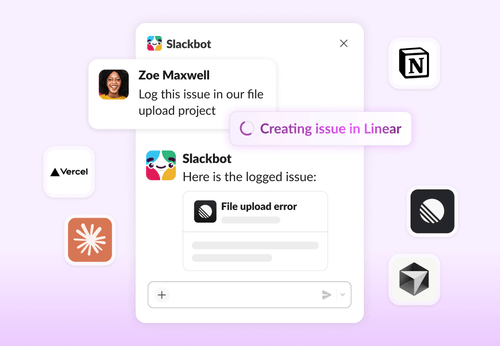
Slackbot is evolving into the single, unified interface for your entire enterprise. With the upcoming Slackbot MCP client, you can integrate any application or agent directly into Slackbot, making it the “front door” for your tech stack. Instead of navigating a dozen dashboards, Slackbot will be able to route your request to the right specialized agent, manage multi-step workflows, and handles the final handoff back to you.
Imagine asking Slackbot to “Finalize the Acme contract.” In the background, Slackbot coordinates with DocuSign to pull the status, pings your legal agent to verify the latest clause, and returns the final link for your signature. By turning Slackbot into a single conversational interface, we aren’t just adding AI to Slack—we’re building the command center for your entire enterprise.
An agent-first future: where conversation meets action
The shift to an agentic enterprise should bring clarity, not complexity. By integrating context-aware agents into Slack and orchestrating workflows through Slackbot, the focus shifts from managing tools to achieving outcomes and getting work done.
Slack and Slackbot are here to ensure that as your AI ecosystem grows, your focus stays on the work that matters. In this agent-first environment, digital and human teammates work side-by-side, workflows disappear into the background, and getting work done is as simple as starting a conversation.
Learn more about the latest Slackbot innovation.
 Awesome!
Thanks so much for your feedback!
Got it!
Thanks for your feedback.
Oops! We're having trouble. Please try again later!