About this use case
Effective employee onboarding encompasses more than filling out paperwork. Each new hire needs to understand their role, find needed information, connect with colleagues, and quickly learn who to ask when they have questions. For hybrid and remote teams, the onboarding process often becomes fragmented across many avenues of communication. New hires are piecing together data from emails, documents, HR systems, meetings, and other tools, which can cause more confusion than clarity.
Slack pulls conversations and resources together into a single, shared workspace. Teams can guide new hires through onboarding activities, from coworker introductions to training and knowledge sharing, without leaving Slack. Keeping all onboarding activities together — and refining them over time — helps organizations build a more consistent, scalable experience for new team members.
How to onboard new employees with Slack
Successful onboarding starts with relationship building. New hires need to connect with colleagues, understand processes and expectations, and deepen their knowledge of company culture, often very quickly. Slack can help simplify that pathway, allowing teams to create onboarding workflows that reduce information overload, inconsistent processes, and missed tasks. Here's how.
Create dedicated onboarding channels
Create a channel dedicated to employee onboarding, where new employees can find announcements, welcome messages, introductions, and answers to frequently asked questions. You can also create team- or department-specific channels so employees can follow pertinent conversations and learn processes.
Use Slackbot to set up training milestones
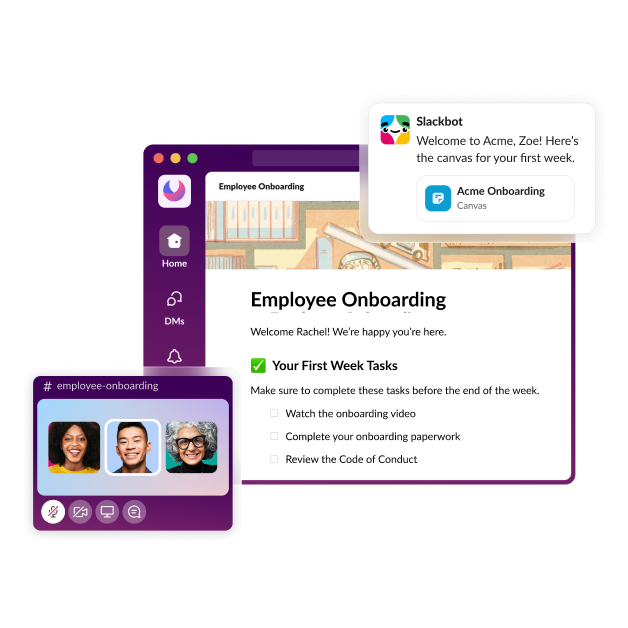
Teams can use Slackbot to deliver reminders, answer common questions, and guide new hires to relevant resources as they move through the onboarding process. For example, Slackbot can deliver automatic reminders to schedule a meeting, complete employee training, or review a policy, helping new team members stay on top of tasks during their first few weeks.
Automate monotonous onboarding tasks with Workflow Builder
Using Workflow Builder, teams can break down the onboarding process into a series of repeatable steps. Use workflow automation to notify managers when new hires complete a milestone or request approvals. Automating these tasks helps cut down on manual follow-up while easing the onboarding process.
Check in with new employees via huddles
New employees often have questions that are easier to answer in person — but not every interaction needs to become a calendar event. Use huddles for spontaneous check-ins, allowing managers to introduce colleagues or answer questions without scheduling a formal meeting.
Create an onboarding hub with canvases
A canvas can serve as a central hub for onboarding information such as team directories, FAQs, company policies, and training materials. Employees will have a single place to check when they have questions instead of searching through emails or scattered documents.
Track onboarding tasks with lists
Use lists to track onboarding tasks, milestones, owners, and deadlines. With a clear set of tasks and expectations, new hires, managers, and HR personnel can hold each other accountable and spot stalled tasks before they slow down the onboarding process.
Get started faster with onboarding templates
Slack's ready-made templates can give HR teams and managers a head start on the onboarding process. Start with adding the new hire onboarding guide for an easy-to-use template you can use to guide employees through their first days and weeks. Complement that with an employee onboarding checklist template to map out the broader onboarding journey. Finally, customize the benefits guide template with your company's benefits information to create a sharable resource for both your new and existing employees.
Connect third-party onboarding tools with integrations
Slack can integrate with tools your organization already uses for onboarding, including HRIS platforms, calendars, document repositories, ticketing tools, learning systems, and identity management solutions. Connecting these systems pulls relevant data into the new hire's workflow right in Slack, reducing the need for context switching.
Slack is where I work with my team all the time, and our goal is to turn Codex into a teammate. The most natural place for that is Slack.
Benefits of using Slack for onboarding
Slack lets you pull onboarding resources and conversations into the workspace you're already using, cutting down on context-switching for both new hires and those contributing to their onboarding process. In that central location, you can make the process more predictable, organized, and collaborative.
Slack helps organizations optimize onboarding in these ways:
- Ramp up new hires faster. With automated reminders and a central repository of onboarding resources, new employees can complete key tasks, find answers, and connect with the right people, helping them reach productivity sooner.
- Create consistent onboarding experiences. Standardize workflows and checklists to make sure every new hire walks through the same series of onboarding steps, no matter their team or location. Developing a consistent onboarding workflow also gives HR and managers a clear process to follow.
- Improve communication across the organization. Internal communication tools such as shared channels and Huddles allow teammates to collaborate with each other and check in with new hires seamlessly, without cluttering your calendar with unnecessary meetings.
- Make it easier to access institutional knowledge. Create a central onboarding hub in Canvas where role-specific resources, training materials, FAQs, and policies are easy to find and revisit. With these resources at hand, new hires spend less time searching for information.
- Reduce manual onboarding work. Use Workflow Builder to automate tasks like notifications, approvals, checklist distribution, and more — reducing repetitive follow-up and giving managers and HR employees more time to focus on employee support.
- Bolster engagement and connection. Slack makes it easier to build rapport between remote team members by providing an avenue for knowledge sharing, informal conversations, and face-to-face meetings. Casual interactions make hybrid and remote hires feel better connected, faster.
What are the best practices for onboarding new employees?
Effective onboarding is an ongoing process, not a single orientation session on an employee's first day. To be successful, the onboarding process must help new hires acquire knowledge and build relationships with colleagues — both of which they'll need to gain the confidence for success. Organizations can follow these best practices to create a fruitful onboarding experience:
- Prepare employees before day one. Communicate clearly with instructions for where to go, what to expect, and any paperwork or training they need to complete before their start date. Creating a welcome message and preboarding checklist helps new employees feel confident and prepared.
- Centralize onboarding resources. Curate onboarding resources such as training materials, FAQs, and policies in a central repository such as Slack Canvas. This gives new hires a clear starting point for finding important information.
- Establish clear communication channels. Ensure that new employees know where to find updates, ask questions, and touch base with colleagues. Establish communication channels for each team and type of request to keep conversations organized and easy to revisit.
- Automate repetitive administrative tasks. Schedule notifications, approvals, and reminders whenever possible to reduce the need for manual follow-ups. Automated onboarding reminders also help prevent missed tasks.
- Encourage early collaboration and relationship building. Introduce new teammates to their colleagues and encourage casual interaction and cross-functional collaboration. Building trust between teammates goes a long way toward later project success.
- Create structured milestones. Set onboarding goals that go beyond the first few weeks. With regular milestones to aim for (such as at 30, 60, and 90 days), new hires gain insight into expectations — and managers have clear opportunities to answer questions and prevent roadblocks.
- Gather feedback and improve continuously. Poll new hires to find out what worked and what didn't. What confused them? What information did they have trouble finding? Use the feedback to refine your onboarding process.
Get new hires up to speed faster with Slack
A successful onboarding process involves more than documentation and training. You also need to establish consistent communication channels, provide accessible information that's easy to find, and connect workflows to help new hires know what comes next — and where to find help when they get stuck.
Slack brings together those puzzle pieces in a single workspace where new hires can connect with teammates, find onboarding resources, complete tasks, and ask questions without context switching. Automated workflows and centralized information simplify onboarding for HR and managers, making tasks easier to manage and report across teams. The result? An onboarding experience that helps new employees gain proficiency, build colleague relationships, and start contributing faster.


