About this use case
Managing all the moving pieces of a sales pipeline becomes more difficult as teams grow, deals get more complex, and customer communication spreads across tools and departments.
Slack offers a solution: Slack CRM helps sales reps, managers, and revenue ops teams manage their pipeline with conversational AI, automated workflows, and real-time CRM updates. The result is a sales team that stays aligned and deals that keep moving.
How to manage a sales pipeline with Slack CRM
Slack CRM is transformational because it turns conversations into real-time pipeline management. Slackbot and a native Salesforce integration automatically capture context, keeping records up to date, spotting next steps, and moving opportunities forward in the place your team is already working. Here's how it works:
Use Slack for conversational pipeline management
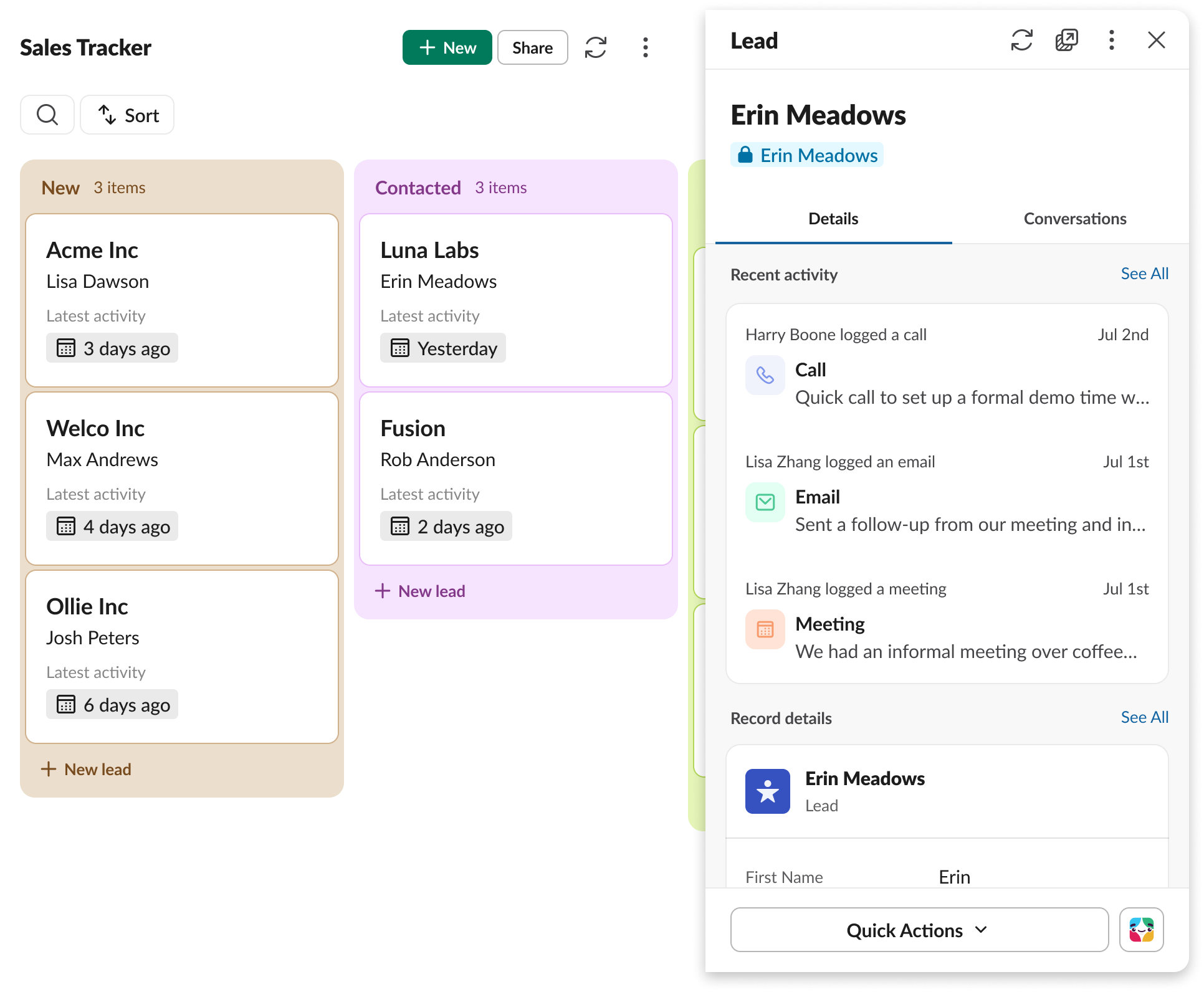
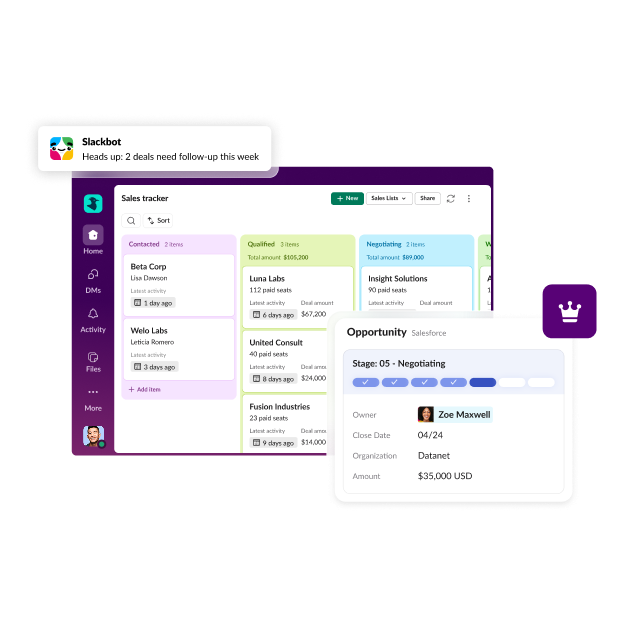
Slack CRM transforms tedious administrative data entry tasks, like manually logging call notes or navigating dashboards to update a deal stage, with Slackbot. You use natural language prompts, and Slackbot updates your daily CRM workflows, so the work feels less like data input and more like a conversation.
- Logging updates: Tell Slackbot to create or update a contact, and it pulls the relevant details from your conversation to populate the record automatically. You spend less time on data entry and more time with customers.
- Moving deal stages: Advance pipeline stages in seconds by telling Slackbot where a deal stands. It keeps CRM records current without the need for you to navigate a separate application.
- Meeting preparation: Prompt Slackbot to generate an account brief before a call. It surfaces past conversations, deal history, and customer context so you walk in fully prepared.
- Smart organization: Use the native agenda view alongside Slackbot's suggested focus areas to navigate your day and prioritize the right accounts.
Eliminate app-switching with built-in Salesforce continuity
Context switching is a productivity killer, and moving between applications causes data to fall through the cracks. Slack CRM is built natively on Salesforce (included in the Business+ plan at no extra cost) to bridge the gap between daily communication and CRM silos.
- Background syncing: Every contact detail and deal milestone captured via Slackbot automatically updates Salesforce in the background, so your CRM records stay accurate without the work of manually transferring data to a separate system.
- Frictionless scalability: Get your small business started in Slack CRM right away with quick implementation. And because data is backed by Salesforce from day one, no migration is required when the business is ready to scale.
Keep pipeline communication and workflow automation in one place
Slack's conversational CRM keeps your team in sync. It gives you a clear home for each account, clarity on what comes next, and a shared space to move deals forward, so everyone stays aligned as the pipeline evolves.
- Organized account channels: Dedicate channels to accounts, territories, or pipeline stages, so you know exactly where to find them. Team members joining a deal mid-stride can use natural language prompts to get key details and see where you left off.
- Automated next steps: Use Slackbot and CRM workflow automation to route task approvals, prompt follow-ups, and send pipeline change alerts, keeping deals moving even when you're pulled elsewhere.
- Deal collaboration: Sales, support, and leadership operate from a shared, single source of truth in dedicated account channels, eliminating the separate briefings and status emails that slow down cross-functional deals.
At first, it felt like a small workflow improvement. But over time, we saw the compounding effect. Better conversations led to better pipeline, which led to better conversions.
Benefits of using Slack for sales pipeline management
Traditionally, managing a sales pipeline meant a lot of manual work: logging call notes, populating records, and searching for context before every customer interaction. On top of that, the output was not always visible when you needed it. Teams that use Slack CRM to manage their pipeline see the following benefits:
- Faster deal progression: Slackbot handles record updates in the flow of conversation, so you spend less time on administrative catch-up and more time advancing deals.
- Better forecasting accuracy: Because context capture is built into your everyday conversations, data is current and comprehensive, giving you a reliable view of what is actually in the pipeline.
- Reduced manual administrative work: Slackbot logs updates, creates records, and syncs data to Salesforce in the background, freeing you from the typical admin tasks that follow every customer interaction.
- Stronger cross-functional collaboration: CRM updates appear in Slack channels where your team already collaborates, so sales, support, and leadership all work from the same current information.
- More consistent follow-ups: Slackbot uses customer context already in Slack to help draft follow-ups quickly, making it easier to reach out with the right message at the right time.
- Faster approvals and escalations: Automated routing sends approvals and escalations to the right person immediately, so deal sign-offs don't sit in inboxes waiting to be found.
- Centralized customer context: Slack CRM keeps records, conversation history, and deal updates in the operating system where work already happens.
What is sales pipeline management?
Sales pipeline management is how you oversee and track deals as they move through the sales process. It's a core responsibility for any salesperson — creating a sales plan, prioritizing opportunities, and predicting future business by tracking key sales actions within each pipeline stage. Your CRM system helps you monitor and evaluate effectiveness through each stage of the process:
- Lead qualification: Determining whether a prospect meets your criteria based on fit, timing, and budget
- Discovery: A conversation to understand the prospect's specific challenges and establish a foundation for moving forward
- Proposal: Presenting your solution and explaining how it addresses the prospect's needs
- Negotiation: Working through terms, pricing, and contract details to reach a mutual agreement
- Closed-won/Closed-lost: Recording the outcome so teams can learn from wins and losses and refine the process — and possibly retarget with marketing campaigns
Seeing how leads progress through these stages directly relates to forecasting accuracy, accountability, and operational efficiency. Slack CRM enables that visibility by keeping records current using conversational updates. The data managers rely on reflects what is happening.
Seven tips for managing a sales pipeline
For teams that want to optimize pipeline visibility, small process changes can have an immediate impact. Here's how:
1. Standardize pipeline stages
Define what moves a lead from one stage to the next, and make sure every rep uses those definitions consistently so the data can be trusted.
2. Keep CRM records updated
Regular updates directly improve forecasting and visibility. A conversational CRM system that accepts natural language removes the friction that keeps reps from updating records.
3. Automate follow-ups and notifications
Sales workflow automation keeps leads active with consistent follow-ups, and Slackbot notifies you as deals progress, keeping everyone informed without manual check-ins.
4. Encourage cross-functional collaboration
Slack CRM lets teams collaborate with full customer context rather than managing work across isolated tools, so the right people can act on the right information at the right time.
5. Monitor pipeline health regularly
Low-friction CRM updates and automated notifications mean pipeline health is always visible, without requiring separate meetings to get everyone current.
6. Prioritize forecasting
Once your CRM platform and processes are in place, forecasting from reliable pipeline data helps you make confident, data-driven business decisions.
7. Centralize customer communication
Within Slack, your central work OS, Slackbot acts as a context-aware AI agent that turns conversations into structured customer records, summarizes activity, surfaces insights, and suggests next steps in the flow of work.
How Slack supports cross-functional sales collaboration
Pipeline management improves significantly when sales, support, leadership, ops, and customer success teams collaborate using the same up-to-date data. With Slack as your work OS, there's no need to jump across inboxes, CRM dashboards, and productivity tools. Slack brings people and information together, allowing sales teams to move deals through the pipeline with reduced friction, AI-supported automation, and no context switching.
Slack is the collaboration layer connecting CRM activity, customer updates, and sales workflows across departments. You can set up customer escalation workflows with Slackbot, or draft follow-up communication when a deal closes using customer context already captured in Slack. Teams across the organization get visibility into pipeline progression, with Slackbot surfacing account summaries and deal status wherever the conversation is happening.