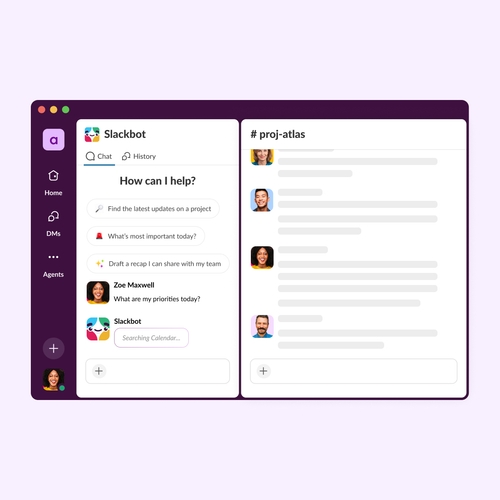
Today’s professionals often have to manage large amounts of written communication daily, across multiple messaging platforms. Producing clear, appropriately toned writing at an accelerated pace creates a significant cognitive load. Luckily, AI message writers can reduce that effort by drafting, refining, and summarizing written communication, without replacing the human judgment behind it.
In this article we’re going to cover how an AI message writer improves communication quality, explain its three primary workplace uses, and help you get started toward using AI tools to create the greatest immediate value for your team.
What is an AI message writer?
An AI message writer is a software application powered by artificial intelligence—specifically large language models (LLMs)—and is designed to generate, edit, or refine written communication using traditional or app-based messaging platforms. These tools analyze prompts, context, and existing written conversations to create customized content, refine messages, and summarize any written communication, saving time and improving efficiency in professional or personal writing.
There are standalone AI message writers and ones embedded in communication platforms, such as the Slackbot context-aware AI agent for work. Embedded tools use actual conversation context to produce more relevant output than generic AI text generators, and the best AI message writers can adjust the tone, length, and format based on the context rather than producing one-size-fits-all drafts. Learn more about conversational AI.
Three uses of an AI message writer
Let’s look at the three highest-frequency communication tasks where message-writer AI systems deliver the greatest time savings and quality improvement.
Use 1: Internal workplace communication
What it is: AI can draft or refine internal messages including status updates, team chat or announcements, project summaries, cross-functional requests, and responses to colleague inquiries.
Why it matters: Internal messages written hastily or ambiguously often create follow-up questions and misunderstandings that slow work and require more hands-on attention. AI message writers can improve clarity and tone across all written communication channels without requiring additional time investment from the sender or follow-ups from readers.
How teams use it: AI helps write clearer workplace messages as the user prompts the tool with a brief summary of what needs to be communicated, and then reviews and adjusts the AI-generated draft (if needed) before sending. Teams can also use AI to adhere to internal communications best practices as well as adjusting tone when a message needs to shift from casual to formal, or vice versa.
Read more about effective business communication techniques.
Use 2: Customer support and marketing outreach
What it is: AI can generate customer service responses, sales follow-up messages, marketing emails, and outreach sequences tailored to the recipient’s context or previous interaction history.
Why it matters: Customer-facing communication requires consistent quality and appropriate tone at high volume. AI message writers help maintain that standard across every response without requiring each team member to produce polished writing independently at scale.
How teams use it: AI message writers, sometimes as a component of a marketing automation platform, can draft first-contact outreach, generate response templates for common customer inquiries, and produce follow-up messages that reference the specific context of the customer relationship.
Learn more about how teams work smarter with Slackbot and AI.
Use 3: Meeting summaries and conversation summarization
What it is: AI can read a meeting transcript, chat thread, or email chain and generate a concise summary including identifying key decisions, action items, and follow-up owners without requiring anyone to manually take notes during the conversation.
Why it matters: AI can summarize long meetings and conversations automatically. Long threads and lengthy recordings often contain critical information that gets lost when participants do not have time to review them in full. AI summarization makes that information accessible in seconds.
How teams use it: Team members can run AI summarization prompts on meeting transcripts (perhaps generated using integrated AI transcription software) immediately after a call, use it to catch up on long channel threads before joining a conversation mid-way, and generate better board meeting minutes and/or recap messages from decision-heavy discussions for stakeholders who were not present.
Learn about the key differences between a conversational AI chatbot vs. assistants.
Key features and best practices for AI message writing
AI writing tools can be enormously helpful, but there are some key differences between AI models as well as a few best practices to consider when using AI message writers.
Features that distinguish effective AI message writers
Not all AI tools are the same. A good AI message writer should be capable of:
- Context awareness: Using the actual conversation or thread as input rather than requiring the user to re-explain the situation via a separate prompt
- Tone adjustment: Adapting formality, length, and directness based on the communication type
- Inline editing: Suggesting improvements to existing drafts rather than replacing them entirely
Best practices
The oft-quoted programming axiom “garbage in, garbage out” (GIGO) always applies when working with AI. Be sure to provide specific context rather than generic prompts. The more the AI knows about the audience and intent, the more accurate the draft will be.
Additionally, you should always review AI-generated messages before sending, particularly for sensitive or vital messages. AI is capable of handling adjustments to structure and clarity, but not of making judgment calls about relationship nuance, cultural sensitivity, or potential compliance issues.
AI is best employed for high-volume, predictable message types, revisions, and/or summation. For sensitive or high-stakes communications, manual writing and review is still the way to go.
For deeper dives, check out our full articles on:
- Assertive communication
- Effective leadership communication examples
- Internal communications strategy
- Productivity AI
- Meet the all-new Slackbot
Get the best AI message writer software with Slack
Slackbot acts as an effective, context-aware AI message writer embedded directly in the Slack platform where workplace communication is already happening. It drafts messages, summarizes threads, refines tone, and generates responses using the actual context of Slack conversations rather than requiring users to switch to a separate AI tool.
For faster message drafting, higher-quality team and customer communication, and automatic meeting summaries without manual note-taking, get the best AI message writer software with Slack. Demo Slackbot or learn more about AI agents today.
FAQs about AI message writers
 Super!
Vielen Dank für dein Feedback!
Okay!
Vielen Dank für dein Feedback.
Hoppla! Wir haben gerade Schwierigkeiten. Bitte versuche es später noch einmal!